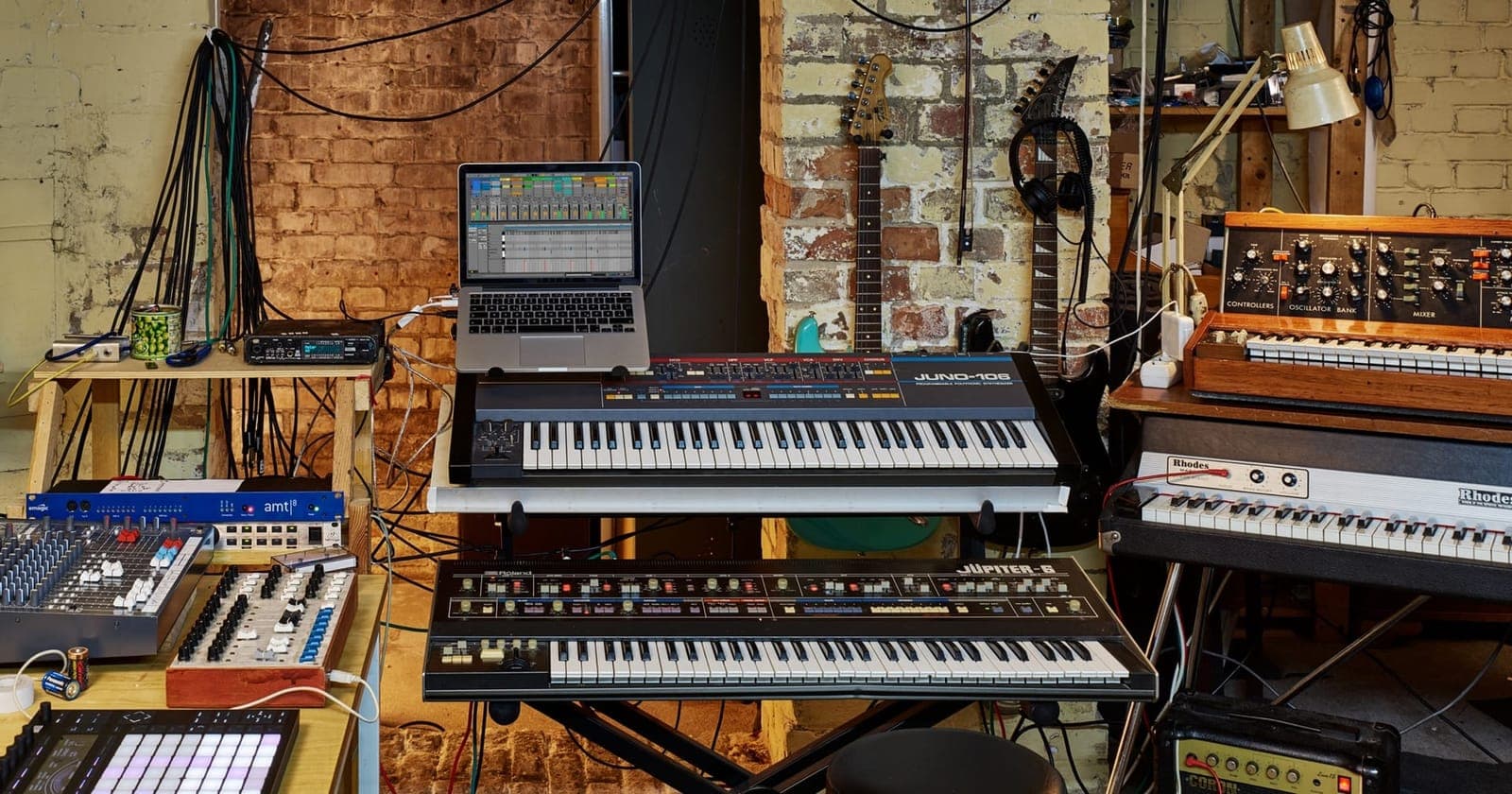
Electronic Sound Art Course | Hong Kong
- →Learn to step sequence from the pros
- →Master creative use of digital effects to create exciting transitions
- →Layer elements to create unique and massive drum sounds
- →Make sub-shattering bass parts
Electronic Sound Art
- →Master creative use of digital effects to create exciting transitions
- →Layer elements to create unique and massive drum sounds
- →Make sub-shattering bass parts
- →Learn to step sequence from the pros
In our students' words.
“The course helped me learn exactly what I wanted to learn and more. It was super hands-on, which will help me retain what I learned in the course for a long time.”
Benjamin S Shirken
Instructors




Before you enrol.
Step sequence like a pro, use digital effects creatively for transitions, layer unique drum sounds, and build sub-shattering bass parts.
18 hours.
Yes - check out student feedback from our longer 360° Academy.
Yes - "Advanced Editing" and "Tweak It!" are both part of the syllabus alongside synthesis and drum programming.
House, Techno, Tech-House, EDM and Bass.
36 Hours | In-Person: $28,800
Ready when you are.
InquireWhy train with us?
Granular and Additive Synthesis
Two advanced methods of sound sculpting - granular synthesis, which builds sound from tiny grains of audio, and additive synthesis, which builds sound from individual harmonics - with the controls, the tools, and techniques for each.
Read →Subtractive Synthesis: Oscillators and Filters
The most widely used form of synthesis - start with harmonically rich waveforms and carve them with filters. Oscillators, detune and unison, noise, mixers, filter types, cutoff, resonance and slopes.
Read →FM Synthesis
Frequency modulation from John Chowning's discovery to the Yamaha DX7 - carriers and modulators, ratios and modulation index, operators and algorithms, and designing FM bells, basses, electric pianos and percussion.
Read →Reaktor Blocks: Modular Synthesis
Modular synthesis inside Reaktor - what Blocks are, how they mimic a Eurorack-style modular system, patching audio and control voltages, building a patch from oscillators, filters, envelopes, sequencers and modulators, and thinking modularly.
Read →Review of Synthesis: Subtractive in Pigments
A synthesis refresher built in Arturia Pigments - oscillators, filters, amplifiers, envelopes and LFOs - using Pigments' virtual analogue engine, its filters and routing, and its modulation system.
Read →Summary of Synths: Prophet, Oberheim and Jupiter
Three legendary analogue polysynths and their Arturia recreations - the Sequential Prophet-5, the Oberheim OB-Xa and the Roland Jupiter-8 - what made each sound distinctive, and how to use them in modern productions.
Read →